
If you have been shopping for a plant-based protein powder on Amazon, you have almost certainly landed on the same two names: Orgain Organic Vegan Protein and Garden of Life Raw Organic Protein. They dominate the category. Both are USDA organic certified. Both use a multi-source plant blend. Both have passionate fans in the reviews. And both cost very different amounts of money. I spent about four months going back and forth between these two, rotating them into the same daily routine, the same smoothie recipes, and the same post-workout windows. Here is what I actually found.
The short answer: Orgain wins for most people. It delivers comparable protein quality at roughly half the cost per serving, mixes cleaner in a shaker, and the chocolate flavor is easier to drink every single day without burning out. Garden of Life has a real case for a specific buyer, but that buyer is narrower than the marketing suggests. Keep reading for the full breakdown.
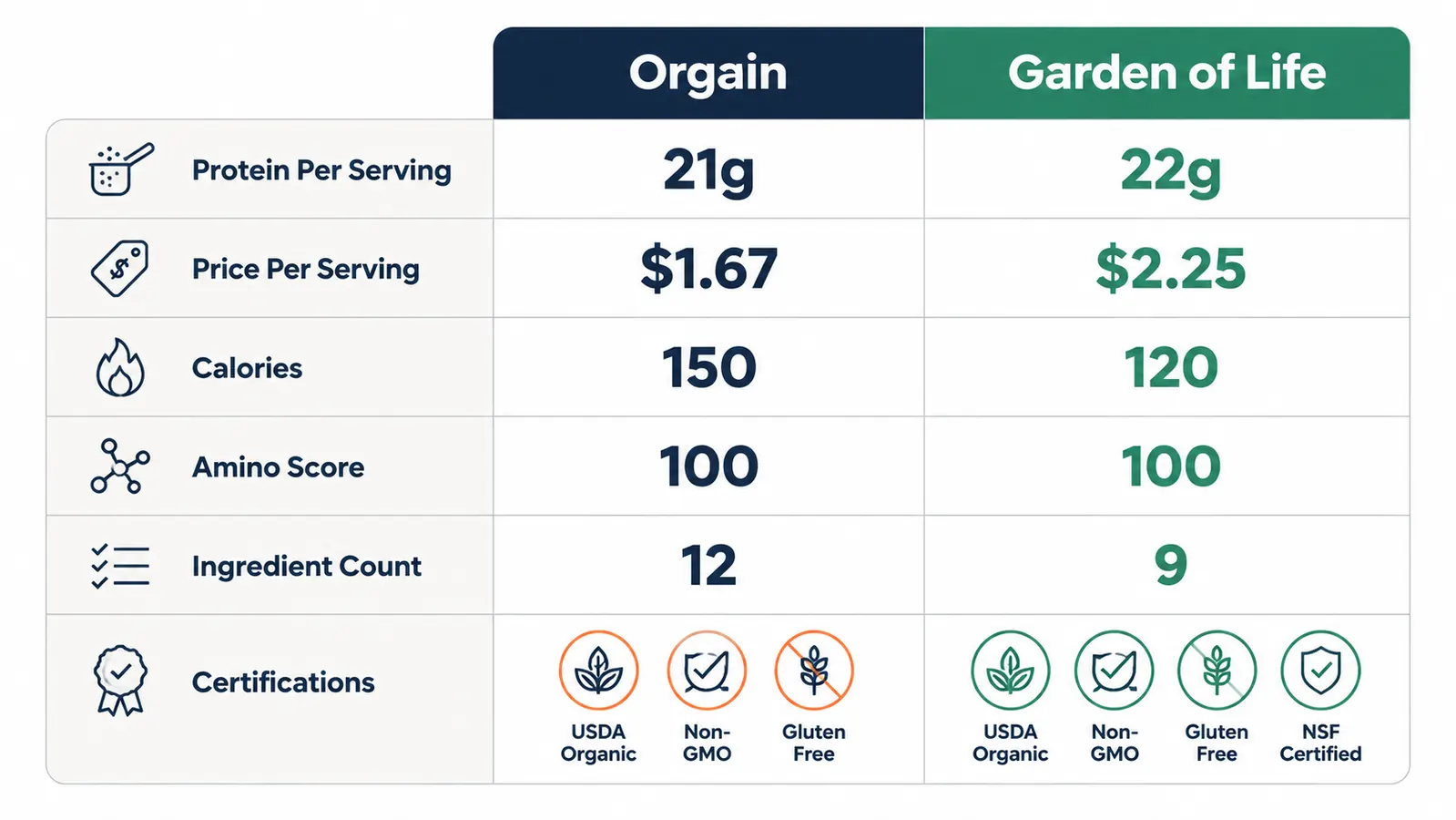
| Orgain Organic Vegan Protein | Garden of Life Raw Organic Protein | |
|---|---|---|
| Price per serving | ~$1.20 | ~$2.30 |
| Protein per serving | 21g | 22g |
| Calories per serving | 150 | 110 |
| Protein sources | Pea, brown rice, chia | Sprouted brown rice, 13 raw sprouts blend |
| Certifications | USDA Organic, Vegan | USDA Organic, NSF Certified for Sport, Vegan, Gluten Free |
| Digestive enzymes | No | Yes (live probiotics + enzymes) |
| Taste (chocolate) | Mild, sweet, easy to drink | Earthy, less sweet, takes adjustment |
| Shaker-bottle mixability | Very good | Moderate, clumps slightly |
Where Orgain Wins
Cost is the clearest win and it compounds over time. At around $29.59 for a 2.03 lb container, Orgain gives you roughly 25 servings. That works out to about $1.18 per serving. Garden of Life's comparable size runs closer to $45 to $50, pushing the per-serving cost past $2.20. If you are using protein powder every day, which is kind of the point, that gap adds up to $30 or more per month. Over a year you are looking at a $360 difference for nearly identical protein delivery. That money can go toward actual food, a gym membership, or more gear. Choosing Garden of Life instead is not automatically wrong, but you need a real reason beyond 'it seems cleaner.'
Taste and daily drinkability go to Orgain too, and this matters more than most reviews admit. Garden of Life's chocolate flavor has a noticeable earthiness that comes from the raw sprouted blend. Some people appreciate it. I found it tolerable in a full smoothie with banana and nut butter, but rough in a simple shaker bottle with just water or almond milk. By week six I started dreading the Garden of Life days. Orgain's Creamy Chocolate Fudge flavor is mild, slightly sweet, and smooth enough to drink plain with water after a workout without convincing yourself to finish the glass. Consistency is a bigger factor in protein supplementation than most people give it credit for. The powder you actually drink every day beats the powder you skip because it tastes like wet soil.
Mixability reinforces this. In a standard shaker bottle with 10 to 12 oz of liquid, Orgain dissolves almost completely within 20 seconds of shaking. There is minimal clumping and no residue ring at the bottom of the glass. Garden of Life clumps more, especially at cooler temperatures, and often leaves a gritty ring that you have to rinse away. Neither is as smooth as a whey isolate, but Orgain gets close enough that the comparison to whey stops feeling insulting. When you are in a hurry after a session, that extra 90 seconds of shaker-cleaning friction matters.
If you want a clean plant protein you will actually finish the bag, Orgain is the one.
Over 64,000 Amazon reviews back it up. Check the current price and see if it ships to you today.
Amazon Check Today's Price on Amazon →
Where Garden of Life Wins
Garden of Life does earn its premium in two specific areas: third-party testing and the digestive enzyme blend. The NSF Certified for Sport certification is serious. It means the product has been tested for substances banned in competitive sports, with actual batch testing, not just a label claim. If you are a tested athlete, a first responder who gets random drug tested, or someone with a specific sensitivity concern who wants lab verification, that certification is worth paying for. Orgain is USDA Organic certified but does not carry NSF Certified for Sport. For the vast majority of recreational gym-goers, this distinction does not matter. For a competitive athlete, it absolutely does.
The live probiotics and digestive enzyme blend in Garden of Life is a real differentiator for people who struggle to digest plant protein. Pea protein in particular can cause gas and bloating for some users, and a built-in enzyme blend helps break down the peptides before your gut has to do all the work. If you know from experience that plant protein wrecks your stomach, Garden of Life's formula is legitimately better suited for you. That said, most people can also solve this by starting with a half serving and building up over two weeks, which works with Orgain too.
The powder you drink every day beats the powder you skip because it tastes wrong. Consistency is a supplement strategy too.
Protein Quality: Are They Actually Different?
Both powders use a pea-dominant protein base. Orgain combines pea protein, brown rice protein, and chia seeds. Garden of Life uses sprouted brown rice protein and a 13-variety raw sprouts blend. The marketing around 'sprouted' and 'raw' implies meaningfully superior amino acid profiles, but the actual lab data tells a more nuanced story. Both deliver all nine essential amino acids. Orgain hits 21g per serving and Garden of Life hits 22g. In practice, that one gram difference is noise. What matters more is leucine content, the amino acid most directly responsible for triggering muscle protein synthesis, and both products deliver roughly 1.7 to 1.9g per serving. Neither reaches the 2 to 2.5g leucine threshold you get from a quality whey isolate, which is a shared limitation of all plant proteins, not a knock on either brand specifically.
If you are plant-based for ethical or environmental reasons and you want to maximize muscle protein synthesis, the practical solution is to use a slightly larger serving, around 1.25 to 1.5 scoops, rather than switching brands. The amino acid composition differences between Orgain and Garden of Life are too small to drive a meaningful outcome change. The price and taste differences are large enough to drive real compliance differences. Compliance wins.
Who Should Buy Which
Buy Orgain if you are a recreational lifter, a home gym athlete, or someone who is new to plant-based protein and wants a low-friction, affordable entry point. It is also the better pick if daily drinkability matters to you, which it should. The savings over a year are significant and the protein quality gap is minimal. This is the right pick for probably 85 percent of people reading this article.
Buy Garden of Life if you are a tested competitive athlete who needs NSF Certified for Sport documentation, or if you have a history of gut issues specifically with plant protein and you want the built-in enzyme support. Also worth considering if you are already used to earthy, less-sweet supplement flavors and the taste profile does not bother you. At twice the price per serving, you should have a clear reason that maps to one of those specific use cases.
How I Tested Both
I rotated between these two powders over about 16 weeks, alternating containers. Same workout schedule: four days per week of strength training, one long run on the weekend. I used each powder in three ways: plain shaker bottle with 12 oz oat milk post-workout, blended into a full smoothie with frozen berries and almond butter, and stirred into overnight oats. I tracked how often I wanted to skip the shake due to taste, how my stomach felt in the two hours after drinking, and whether I noticed any difference in next-day soreness or training energy. I did not change my sleep, food, or training volume during the test period.
The results were consistent enough across the 16 weeks that I am confident they are real and not just early-adjustment variation. Orgain was more drinkable in every format. Garden of Life was noticeably harder to get through plain. My recovery and performance felt equivalent across both, which matches what the amino acid comparison would predict. The gut response was also equivalent for me, though I do not personally have a history of plant protein sensitivity.

The Honest Cons for Each
Orgain's weaknesses: the ingredient list includes organic cane sugar and organic erythritol, which keeps the flavor profile pleasant but means it is not the leanest option if you are aggressively tracking macros. At 150 calories per serving, it is also 40 calories higher than Garden of Life's 110. If you are in a cut and watching every calorie, that gap matters over time. Also, the 2.03 lb bag size is relatively small. You will burn through it faster than you expect.
Garden of Life's weaknesses beyond taste and price: the scoops are smaller and the label is sometimes confusing about serving size versus scoop size. Some batches mix notably grittier than others, which suggests some batch-to-batch manufacturing variation. The 'raw' labeling is also a marketing term more than a nutritional claim at this point. And if you care purely about protein per dollar, Garden of Life is not a strong value play at any price point compared to its competitors.
Final Verdict
If this were purely a nutrition science comparison, the two products would be close to a tie. But supplementation is not a nutrition science quiz. It is a daily habit. The product that is affordable enough to buy consistently, tastes good enough to actually drink, and mixes cleanly enough that you do not resent the prep is the one that will produce results. On every one of those practical measures, Orgain has the edge. Garden of Life earns its premium for a narrow buyer with specific certification or digestive needs. For everyone else, Orgain is the smarter buy. Check the internal links below if you want a deeper dive into either product on its own.
Orgain is the plant protein most people will actually stick with. Here is where to get it.
With over 64,000 ratings and a price per serving that beats every comparable organic plant protein, it is worth checking the current price before it moves.
Amazon Check Today's Price on Amazon →